REVIEW · SAN MIGUEL DE ALLENDE
Queretaro: City Tour in Classic Ford T Vehicle
Book on Viator →Operated by oh! Turismo que inspira · Bookable on Viator
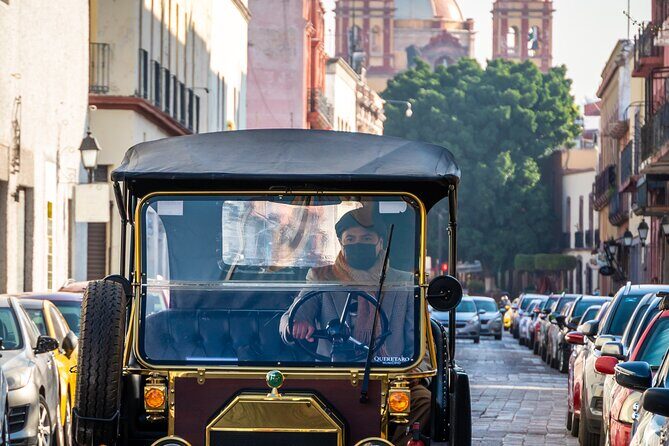
Ride history in a tiny classic car. This Querétaro city tour takes you past big-name landmarks in Santiago de Querétaro’s Centro while your guide tells the stories behind them. Expect legends, key religious sites, and the city symbols locals actually talk about—without spending the whole day on your feet.
I especially love the way the tour blends quick sighting time with real context, from a 19th-century crime tale to the 1531 battle that helped set the stage for Santiago de Querétaro. I also like the comfort factor: when it’s hot, you’ll appreciate covering ground without constant walking.
One consideration: it’s about 1 hour, so you’ll be moving through several stops and learning as you go. If you want long time inside museums or to linger for photos, you may wish for a longer visit.
In This Review
- Key highlights at a glance
- The smart way to do Centro: a Ford T-style ride
- Where the tour starts (and why it helps)
- Stop 1: the haunted legend linked to Zacatecas mineral
- Stop 2: Colegio de Propaganda FIDE and the thorn-cross detail
- Stop 3: the 1531 battle site behind Santiago de Querétaro
- The 74-arch city symbol and the aqueduct legend
- Handicrafts stop: indigenous art from Querétaro
- Centro Cultural Antigua Estación de Ferrocarril (15 minutes, free)
- Cerro de las Campanas: the chapel tied to the Second Empire
- What you’ll realistically get done in about 1 hour
- Price and value: is $17.91 a good deal?
- Who this tour fits best (and who might want something else)
- Should you book it?
- FAQ
- How much does the Querétaro City Tour in a classic Ford T cost?
- How long is the tour?
- Is the tour offered in English?
- Do I need a printed ticket?
- What is the maximum group size?
- Are service animals allowed?
- What’s the weather situation?
Key highlights at a glance
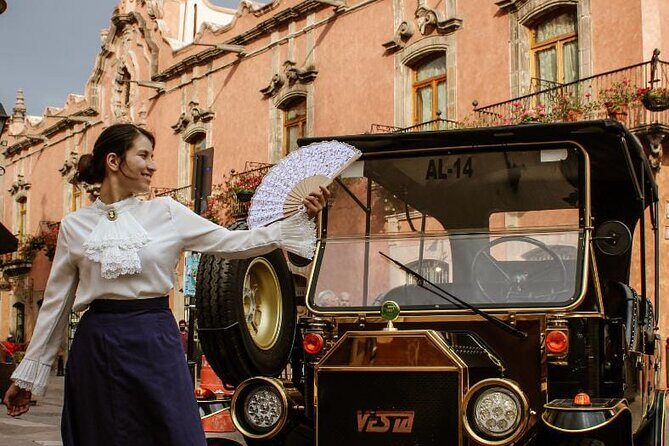
- Classic Ford T vibe: See the Centro loop without turning it into a marathon.
- Legend-led stops: Stories cover haunting houses, religious symbols, and old battles.
- Big landmarks in a small time window: Aqueduct arches, railway heritage, and a famous hill chapel.
- Two time-boxed ticket stops: Centro Cultural Antigua Estación de Ferrocarril and Cerro de las Campanas.
- Small group feel: Maximum of 15 travelers keeps it more personal.
- Hot-day practical: Less sun-on-foot and more shade-and-breeze time.
The smart way to do Centro: a Ford T-style ride
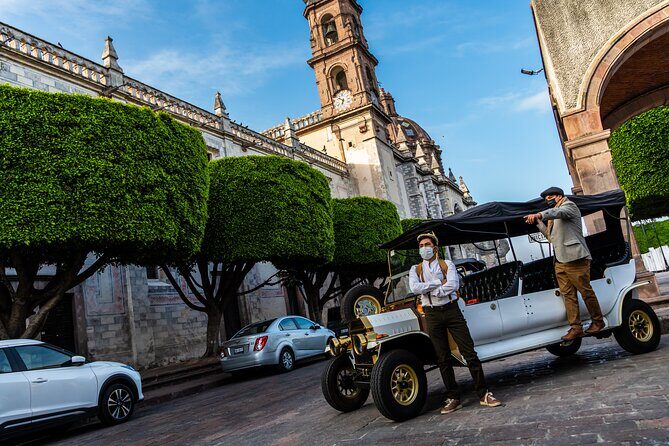
Querétaro can be easy to explore slowly—if you have the time and energy. This tour is built for a different kind of traveler: you want the main sights, you want the meaning behind them, and you’d like to be done before your legs file a complaint.
The route centers on Santiago de Querétaro’s Centro, where you’ll pass some of the city’s most recognizable scenes. The car format matters. You’re not stuck standing in one spot for an hour; you’re getting movement plus commentary. On a hot day, that alone makes the tour feel practical, not just fun.
With a maximum of 15 travelers, it also tends to feel easier to ask questions and get attention when you need it. And the tour is offered in English, which matters if you’re trying to follow legends and dates without guessing.
You can also read our reviews of more city tours in San Miguel de Allende


Where the tour starts (and why it helps)
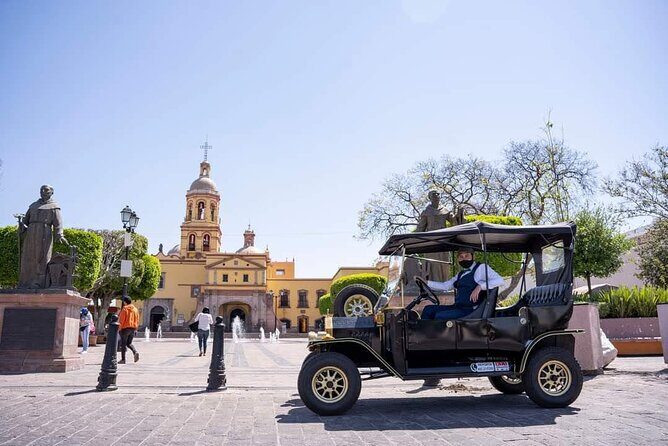
You meet at oh! Turismo Querétaro, located at C. Independencia 64C, Centro, 76000 Santiago de Querétaro, Qro., Mexico. The tour ends back at the same meeting point, which is great for planning. You don’t have to think about a new pickup zone or how to get back across town.
One small lesson I’d give you: arrive a few minutes early if you can. In past tours, the guides have been flexible when people got turned around, but you’ll have a smoother start if you’re already in the right spot. (One guide named Charlie reportedly waited when someone was late due to getting lost on the way.)
Stop 1: the haunted legend linked to Zacatecas mineral
The first stop comes as you pass by a story that sounds like it belongs in a novel—but it’s tied to local history. You’ll learn about a 19th-century crime involving a couple from the Zacatecas mineral. Today, the location is connected to a museum of decorative art, with the added layer of tales about ghosts that are said to haunt the old house.
This is the kind of stop I like because it doesn’t just name-drop. It gives you a reason to look at the building with curiosity instead of treating it like scenery. Even if you don’t usually buy into ghost stories, the legend helps you remember what you’re seeing.
Possible drawback: since this is presented as you pass, you won’t get long photo time or deep exploration. Treat this stop like a hook. The tour is about context and orientation for the rest of your day.
Stop 2: Colegio de Propaganda FIDE and the thorn-cross detail
Next up is the Colegio de Propaganda FIDE, linked to the Franciscan evangelizers who left it behind. Inside, there’s a striking religious symbol: a tree of thorns shaped like a cross.
This is one of those places where the meaning tends to land fast. You’re seeing a form of symbolism that’s meant to provoke thought and devotion. And because your guide frames it in the context of evangelization, you get more than an aesthetic moment—you get a story of how faith was expressed through architecture and objects.
Tip for photos: if you’re shooting through a doorway or windows, be ready to adjust. Bright outside light can wash out interior details. Quick adjustments will get you better results than hoping for perfect lighting.
Stop 3: the 1531 battle site behind Santiago de Querétaro
After that, you’ll head to the place where, in 1531, the battle took place that helped lead to the foundation of Santiago de Querétaro.
This stop is valuable because it connects the modern city center to the moment that shaped its origin. You get a timeline anchor. You can look at today’s streets and buildings, but now you also understand the earlier stakes: territory, conflict, and the beginning of something that became a lasting settlement.
As with several stops on this tour, it’s not meant to replace a full archaeological or academic visit. But it’s an efficient way to make the city’s layout feel less random.





The 74-arch city symbol and the aqueduct legend
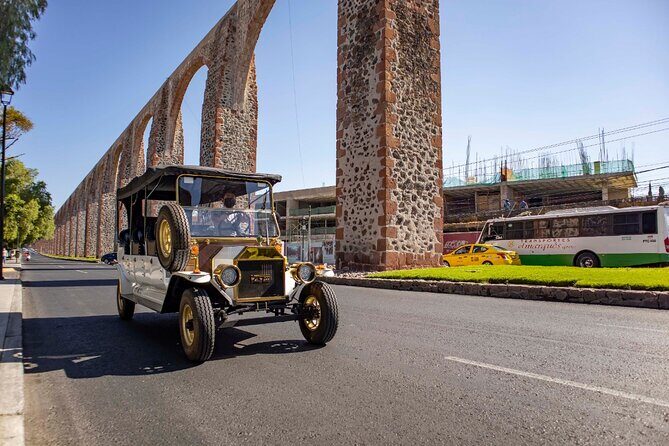
Now you hit a big one: the symbol of the city known for its 74 arches and an extension of 1280 meters. This is connected to the work of the Marques de la Villa del Villar del Aguila. During the visit, you’ll also hear the legend linked to this emblematic place.
Even if you’ve seen aqueducts before, this kind of stop works because it combines engineering-scale details with human storytelling. When your guide tells you the numbers—74 arches, 1280 meters—it stops being just a landmark. It becomes a reference point you can use to orient yourself in Centro later.
Practical photo advice: choose one angle for full context and then one closer shot for texture. These arches look great from a distance, but close-ups tell you how the structure repeats and holds up.
Handicrafts stop: indigenous art from Querétaro
There’s also a stop devoted to the sale of handicrafts from indigenous regions of the state of Querétaro. For many people, this becomes the easiest “I should buy something small” moment of the day.
I like these stops because they’re low-pressure. You’re not rushed out of the city for shopping. You’re still in the historic flow, and you can browse while your guide keeps the historical rhythm going.
One suggestion: go in with an idea of what you want to carry home. If you’re buying for gifts, set a budget before you see too many options. Short tours have a way of turning browsing into overbuying.
Centro Cultural Antigua Estación de Ferrocarril (15 minutes, free)
Next is Centro Cultural Antigua Estación de Ferrocarril. This railway station was inaugurated by President Porfirio Díaz, and you’ll spend about 15 minutes here. The admission is free.
This stop gives your tour a “modernization” layer. You’ve been hearing about evangelization, legends, and battles, and now you’re seeing a sign of how the country’s transport and public life evolved later. It’s a nice contrast stop, especially if your brain has been stuck in old-world storytelling.
Because your time here is limited, focus on two things:
- Find the architectural features you’d notice even without a guide.
- Listen while your guide explains why the station matters.
Quick note: stations can be spread out in layout. So if you’re trying to capture a wide shot, stand where you can get both the building and the rail-era feel in one frame.
Cerro de las Campanas: the chapel tied to the Second Empire
The final major stop is Cerro de las Campanas, with a chapel marking the end of the Second Empire in Mexico. You’ll have about 15 minutes and the admission ticket is included.
This is the stop that tends to feel more emotionally focused. It’s not just a viewpoint. It’s tied to a political turning point, and the chapel setting helps the story land.
If it’s sunny, you might want to wear something that handles heat well—cap, sunglasses, water if you can. Even though you’re riding part of the route, Cerro de las Campanas is a place where your attention naturally gravitates upward and outward.
What you’ll realistically get done in about 1 hour
The full tour experience is about 1 hour. That means you’re getting a “great overview plus a few anchors,” not a slow, deep-dive into every site.
Here’s the practical rhythm you should expect:
- Several legend-rich pass-by moments (fast, story-heavy).
- A quick cultural station stop (free, 15 minutes).
- A focused hill chapel visit (ticket included, 15 minutes).
If you’re the type who loves reading plaques and spending time inside, you’ll likely want follow-up time after the tour at one or two places you liked most. The advantage is you’ll know what to choose next.
Price and value: is $17.91 a good deal?
At $17.91 per person for about an hour, this tour is priced like a budget-friendly way to see multiple highlights with interpretation. Where it earns value isn’t the vehicle alone—it’s the mix of landmarks plus guided storytelling in a compact format.
Also, two key items help with value:
- Centro Cultural Antigua Estación de Ferrocarril is free.
- Cerro de las Campanas includes the admission ticket.
You’re not paying separately for the main on-site experience stops, which is a smart way to keep your total day spend predictable.
And because the group is kept to up to 15 travelers, you’re not just buying a bus ride. You’re buying guidance and pacing, which makes the stops feel connected rather than random.
Who this tour fits best (and who might want something else)
This is a strong pick if you:
- Want a fast introduction to Querétaro that still includes stories and context.
- Prefer comfort in heat over long walking.
- Like getting city orientation early, so you can explore on your own afterward.
- Enjoy history that’s told in a human way—legends, religious symbols, and key moments.
You might want a different option if you:
- Need lots of time inside buildings and museums.
- Don’t enjoy quick stops with limited photo time.
- Are traveling when conditions are poor, since the experience requires good weather.
Should you book it?
Yes—if you want a high-value, short way to understand Querétaro’s Centro and see the most talked-about landmarks without spending your whole day walking. The Ford T-style ride plus the story-led stops make the hour feel organized, not rushed-for-rushed-sake.
If you’re deciding between “do nothing” and “do a quick highlight tour,” this is the better move. It gives you names, dates, and symbols you can actually use later while exploring on your own.
FAQ
How much does the Querétaro City Tour in a classic Ford T cost?
The price is listed as $17.91 per person.
How long is the tour?
The duration is about 1 hour.
Is the tour offered in English?
Yes, the tour is offered in English.
Do I need a printed ticket?
You’ll receive a mobile ticket.
What is the maximum group size?
The tour has a maximum of 15 travelers.
Are service animals allowed?
Yes, service animals are allowed.
What’s the weather situation?
This experience requires good weather. If it’s canceled due to poor weather, you’ll be offered a different date or a full refund.