REVIEW · CITY TOURS
Walking Tour of the Historic Center of Mexico City
Book on Viator →Operated by Kactus Free Walking Tour · Bookable on Viator
Mexico City hits you fast—then explains itself. This small-group walk through the Historic Center of Mexico City connects pre-Hispanic and colonial Mexico in one continuous route. I love how you move from the political heart of the Zócalo to the Templo Mayor area, so the city’s layers make sense. I also like that the tour includes a ticketed stop at Museo Vivo del Muralismo, where you see a big slice of Diego Rivera’s work.
One fair warning: there’s a lot of walking on uneven surfaces, and there aren’t many places to sit. If you’re not used to the altitude, plan for extra breaks—your guide will usually work with the group, but the cobblestones and pacing still matter.
Key highlights at a glance
- Max 10 people means you can actually ask questions and keep a comfortable pace
- English-language guides with strong storytelling, often with humor that fits the streets
- Ticketed stops included at Museo Vivo del Muralismo and Ventana Arqueológica
- Most major sights are exterior views, so you’re not burning time on entrances everywhere
- A route built for orientation: Zócalo → murals → plazas → Bellas Artes area photo finish
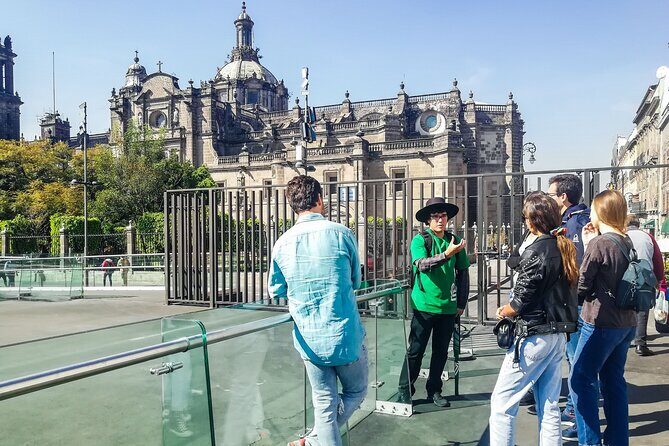
- Easy to spot your guide (green shirts and umbrellas show up in the crowd)
In This Review
- Zócalo First: The Whole City’s Rhythm in One Plaza
- Catedral Metropolitana: Baroque Meets Neoclassical Outside
- Templo Mayor Outside Views: Rain, Sun, and the Mexicas Connection
- Museo Vivo del Muralismo: Diego Rivera’s Big Slice, Right Where He Painted
- Plaza de Santo Domingo: The Viceroyalty’s Power, Trade, and Conflict
- Plaza Tolsa: Shadows, Day of the Dead, and the Little Horse
- Ventana Arqueológica: A Window Into the Past Under a Street
- Palacio de Bellas Artes: Art Everywhere, Even in the Air
- Palacio Postal and the House of Tiles: Final Big Wins for Photos
- Pace, Comfort, and What to Expect on 3 Hours of Centro Histórico
- Value and Tickets: Why the Included Entries Matter
- Who This Tour Fits Best (And Who Might Want Something Else)
- Should You Book This Walking Tour?
- FAQ
- How long is the Walking Tour of the Historic Center of Mexico City?
- Is the tour offered in English?
- What’s the maximum group size?
- Where does the tour start and end?
- Which stops include admission tickets?
- Are there admission fees at stops like the Catedral Metropolitana or Palacio Postal?
- Do I get a mobile ticket?
- What happens if the weather is poor?
- Is free cancellation available?
Zócalo First: The Whole City’s Rhythm in One Plaza
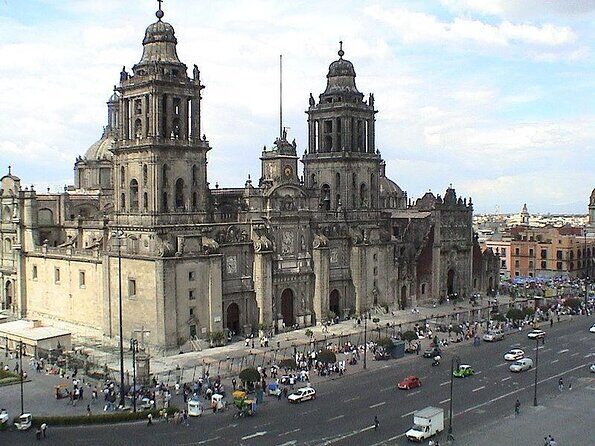
Your tour starts at Plaza de la Constitución, the Zócalo, which is the kind of place where Mexico City feels like one giant stage. From here, you’re surrounded by power, history, and today’s daily life all at once. You’ll see the National Palace and the Supreme Court of Justice nearby, plus the shops that make this square feel like a living marketplace rather than a museum.
What I like about beginning here is that it gives you a map in your head. Even if you’re new to the city, the Zócalo acts like a compass point. You learn how people gather here, why this area matters politically, and how it ties into the older spiritual centers of the region.
Practical tip: the Zócalo can be crowded. If you want photos, you’ll get better results when your guide gives you a specific angle to stand and wait for the right moment.
Catedral Metropolitana: Baroque Meets Neoclassical Outside
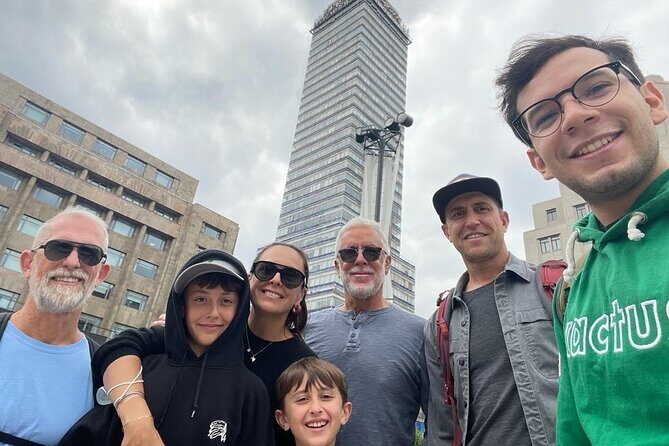
Next comes the Catedral Metropolitana de la Ciudad de Mexico. You mostly experience it from the outside, with your guide pointing out how its construction history shaped what you see today. The cathedral is a visual argument: styles shift, but the building’s mission stays the same—religion, authority, and identity in stone.
Even without going in, the exterior is worth your time. Look for details that reflect the mix of Baroque energy and later neoclassical control. Your guide explains the origins and why this cathedral became such a major landmark for colonial Mexico.
Consideration: cathedral entry is not included, so if you strongly want an inside visit, you may need to plan that separately.
Templo Mayor Outside Views: Rain, Sun, and the Mexicas Connection
Between the cathedral and the mural stop, you’ll shift to the Templo Mayor area—focused on archaeological ruins dedicated to the god of rain and the god of the sun. This is where your walking tour stops being only about pretty buildings and becomes about worldview.
Your guide explains why the Mexicas built here and how the site’s importance connects to geography. You’ll understand why this area wasn’t just “old stuff in the middle of the city.” It was a center tied to the natural world, astronomy, and civic life.
This segment works especially well if you like context. You’ll start noticing how modern streets sit above layers of older space, and the city’s design starts to feel intentional instead of random.
Museo Vivo del Muralismo: Diego Rivera’s Big Slice, Right Where He Painted
The highlight for many people on this tour is the Museo Vivo del Muralismo inside the Ministry of Education. You’re not just seeing murals. You’re stepping into an environment that helped make muralism a public story about Mexico in the early 20th century.
You’ll see a third of the murals Diego Rivera painted throughout his career. That’s a huge deal, because Rivera’s themes show up in a way that feels political, social, and everyday all at once. The murals connect to festivals, traditions, social struggle, trade, and politics—so you’re not stuck with one mood or one theme.
Time is about 25 minutes here, which is long enough to get the point without turning the visit into a marathon. Your guide helps you “read” what you’re looking at—so you know what to notice instead of just admiring brushwork.
Value angle: this is one of the ticket-included parts of the route. Even if you’re not a mural fanatic, it’s the stop where the tour earns its ticket value.
Plaza de Santo Domingo: The Viceroyalty’s Power, Trade, and Conflict
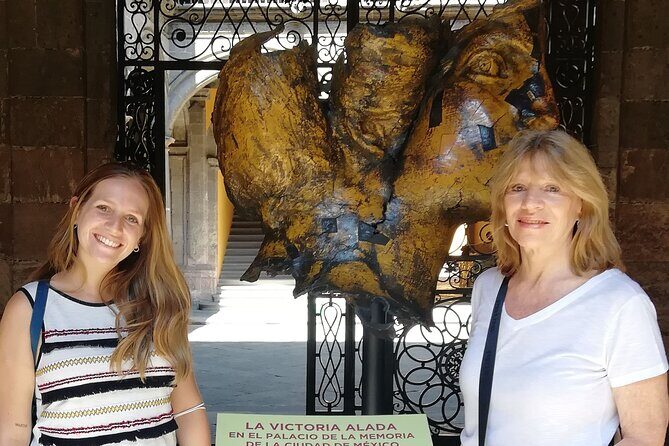
Plaza de Santo Domingo is one of those squares where the history feels like it’s still in the walls. You’ll visit this area tied to major events in the viceroyalty of New Spain, and you’ll hear how trade networks shaped life here.
Your guide also connects the square to big historical forces: commerce of spices and products with Asia, the presence of the holy inquisition, and the attempts of France to conquer Mexico. Hearing those topics placed into the geometry of a real square helps you understand how policy and culture overlapped in daily life.
This is also a nice moment for your brain to switch modes. After the Templo Mayor and Rivera murals, you’re back to public space—plazas as stages for power.
Plaza Tolsa: Shadows, Day of the Dead, and the Little Horse
Plaza Tolsa gives you a small reset. It’s a good place to rest in the shadows, and your guide uses the stop for a wider set of themes beyond buildings.
You’ll talk about indigenous languages and traditions, including the day of the dead, plus music, politics, and gastronomy. This isn’t random trivia. It’s the everyday Mexico that explains why the historic sites aren’t frozen in time.
You’ll also see the equestrian statue of Charles IV, often called the little horse. It’s a recognizable sight and an easy photo anchor. And while you’re here, you’ll get exterior looks at the National Museum of Art and the Mining Palace, which helps connect the squares to the broader cultural map of Centro Histórico.
Practical tip: this is one of the better opportunities to slow down. If you need a water break or a quick bathroom stop, this is typically the kind of moment your guide can work with.
Ventana Arqueológica: A Window Into the Past Under a Street
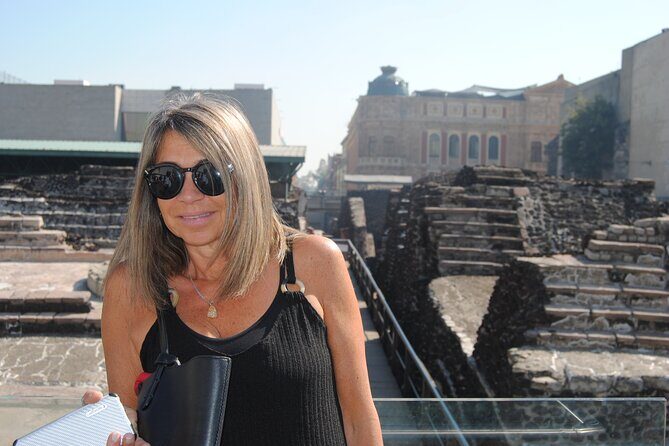
Ventana Arqueológica is one of the most fun ideas in the whole route: you look down through a preserved window into the past next to the main temple. Your guide explains how it was found and why the site matters.
This stop is about making the hidden history visible. You’ll understand that many buildings in Mexico City’s center hide stories underfoot—not just one dramatic ruin, but a whole layer cake of earlier life.
Time here is short (about 5 minutes), but it lands hard. You get a clear reminder that the city is still being built on top of older city plans and older meanings.
Ticket value: this is another ticket-included stop. In a 3-hour tour, adding just one or two paid entries usually won’t feel heavy—Ventana Arqueológica is the kind of stop that makes those entries feel worth it.
Palacio de Bellas Artes: Art Everywhere, Even in the Air
Then you reach Palacio de Bellas Artes, the must-see finale for many first-timers. The interior and exterior both matter here, and the building tends to make people pause without realizing it.
Your guide frames it as more than an architectural icon. You’re learning how public art and national identity meet in a place people still treat as a cultural center.
This is also where your tour’s route makes sense. After learning pre-Hispanic spirituality, colonial religion, murals, and plaza politics, you end in a building that represents modern Mexico’s idea of culture and nationhood.
Photo tip: save your best camera focus for the moment your guide gives you a specific perspective. The building looks different from different angles, and you’ll want at least one clean wide shot plus a detail shot.
Palacio Postal and the House of Tiles: Final Big Wins for Photos
Two more stops round out the route on the way to the finish near the tile house.
First is Palacio Postal. You’ll look at a majestic palace that’s still in operation, and your guide ties it to the economic and political consequences of building something this grand. Even if you don’t go inside (admission is not included), the exterior story helps you understand why communication infrastructure mattered.
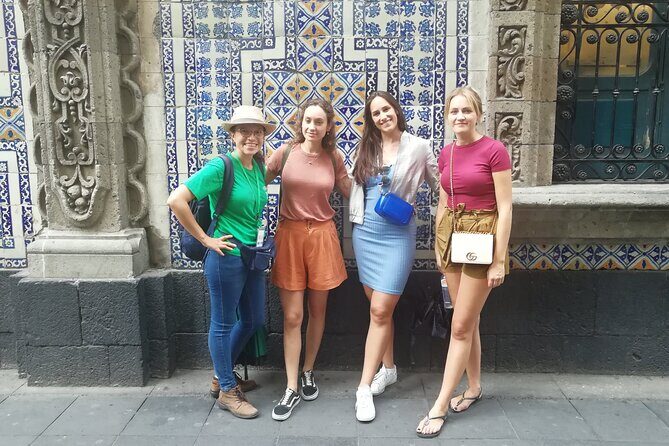
Then comes the House of Tiles (Casa de los Azulejos), one of Mexico City’s most photographed icons. The famous tiles give it instant visual identity, and it’s exactly the kind of “I get it now” landmark you want at the end of a tour—because by the time you reach it, you’ve already built context for what makes the city different.
The tour finishes at the side of Palacio de Bellas Artes and the tile house, which is perfect if you want to keep walking on your own afterward.
Pace, Comfort, and What to Expect on 3 Hours of Centro Histórico
This is a walking tour, and it’s built for moving. Expect cobblestones and tight sidewalk moments. Some people feel slowed down by uneven surfaces, and groups can stretch out if anyone needs extra time.
You’ll also be outdoors for long stretches. Several guides are careful about hot sun and street crossings, and you should take that as a clue: bring sun protection and plan for slow-down moments.
The best part is that with a small group (up to 10), your guide can usually manage pacing without turning the tour into a sprint. Many people love the way guides balance history with time to ask questions, plus the ability to handle quick group needs like bathroom breaks.
If you want the best experience, wear shoes you can trust on uneven ground. If you’re sensitive to altitude, build in your own flexibility. This isn’t a “see everything in one hour” tour. It’s a “make sense of the center” tour.
Value and Tickets: Why the Included Entries Matter
Even without knowing the exact price, you can judge value by how the tour uses your time.
Most stops are free to see from the outside. That keeps costs down and time efficient. The two ticket-included stops—Museo Vivo del Muralismo and Ventana Arqueológica—are the ones that add real depth. They’re not “look through a doorway” moments. They’re the parts where you get specific access: Rivera murals in a formal interior setting, plus an archaeological view under the street.
So the value logic is simple: you pay (through the tour price) for two higher-impact, harder-to-replicate experiences, while the rest supports orientation and context through plazas, exteriors, and stories you can’t easily piece together alone.
Also, the tour is offered in English, and you get a mobile ticket. That’s useful when you’re trying to keep the day simple.
Who This Tour Fits Best (And Who Might Want Something Else)
This walking route is ideal if you want a strong orientation day. It’s also a good match if you like blending big themes—pre-Hispanic Mexico, colonial power, and early-20th-century politics—into real places you can later revisit on your own.
I’d especially recommend it to first-timers who feel overwhelmed by Centro Histórico. Seeing Zócalo, then the Templo Mayor area, then Rivera murals, then major cultural landmarks helps you build a mental map fast.
If you have limited mobility or you hate uneven walking, consider a different format. The route includes cobblestones and long stretches with limited seating, and the pace matters.
Should You Book This Walking Tour?
Book it if you want the historic center explained in plain language, with a route that mixes major landmarks and meaningful context. The small-group format (max 10), English delivery, and the two ticket-included stops make it a strong way to spend a short time in Mexico City.
Skip it if you’re looking for a slow, sit-down museum day. This tour is more about walking, spotting, and understanding what you see as you go.
If you do book, plan for sun, wear solid shoes, and come ready to ask questions. When guides like Fer, Fernanda, Luis, Nat, Alexia, Gabby, Thomas, Eduardo, Benjamin, Oscar, Sarah, and others are leading, the tone tends to be personal and story-driven—exactly what helps the city’s layers click.
FAQ
How long is the Walking Tour of the Historic Center of Mexico City?
It’s approximately 3 hours.
Is the tour offered in English?
Yes, it’s offered in English.
What’s the maximum group size?
The tour has a maximum of 10 travelers.
Where does the tour start and end?
It starts at Plaza de la Constitución in Mexico City’s Centro Histórico. It ends near Palacio de Bellas Artes and the House of Tiles.
Which stops include admission tickets?
Admission is included for Museo Vivo del Muralismo and Ventana Arqueológica.
Are there admission fees at stops like the Catedral Metropolitana or Palacio Postal?
Admission for the Catedral Metropolitana and Palacio Postal is not included.
Do I get a mobile ticket?
Yes, the tour provides a mobile ticket.
What happens if the weather is poor?
This experience requires good weather. If it’s canceled due to poor weather, you’ll be offered a different date or a full refund.
Is free cancellation available?
Yes. You can cancel for a full refund up to 24 hours in advance of the experience start time.